
Health Insurance Terms: Costs and Coverage Explained
Protecting your finances starts with understanding basic health insurance terms, especially related to costs and coverage. Our main topic article, Decoding Health Insurance Literacy, explains how health insurance literacy is one of the most effective ways to protect your physical and financial health. Understanding basic health insurance terms is foundational to choosing a health plan that fits your needs and budget, as well as estimating and controlling out-of-pocket costs. Before comparing, buying, or using health insurance, it may be helpful to review the basic vocabulary of health insurance terms.

Understanding Core Health Insurance Cost Terms
While insurance paperwork can be dense, most plans rely on a standard set of financial terms used to define how covered healthcare costs are split between you and your health insurance plan.
Premium
Your premium is the fixed amount you pay for your insurance every month, whether you visit a doctor or not. Think of it like a subscription fee that keeps your coverage active.
Cost-Sharing and Out-of-Pocket Costs
Cost-sharing is the portion of your healthcare costs you must pay out-of-pocket while your insurance plan covers the remaining balance. This is the amount you are financially responsible for and includes copays, coinsurance, and deductibles.
Under private health insurance and Medicare, “out-of-pocket costs” generally only refer to cost-sharing incurred when a person has medical claims (even though premiums are also paid out-of-pocket).
Deductible
This is the amount of money you must pay out of pocket for medical care before your insurance starts sharing the costs. For example, if you have a $2,000 deductible, you generally pay the first $2,000 of your medical bills before the insurance company begins paying its share.
Note: If you have insurance that’s compliant with Affordable Care Act (ACA) mandates, many preventive care services, like annual physicals, are usually covered 100% even if you haven’t met your deductible yet.
Copayment (or “Copay”) and Coinsurance
Once you’ve met your deductible, you still share costs with your insurer under most plans using one of these two methods. A copay is a flat fee for specific services, such as a $25 charge for a primary care visit. Coinsurance is a percentage of the total bill—such as 20%—that you pay, while the insurer covers the remaining 80%.
Out-of-Pocket Maximum
Out-of-Pocket Maximum is your financial safety net. It represents the most you will have to pay for covered services in a single plan year. Once your cumulative spending on deductibles, copays, and coinsurance hits this ceiling, your insurance pays 100% of all covered medical costs for the rest of the year. For some plans (especially high-deductible plans), the out-of-pocket maximum may be the same amount as your deductible, but it’s usually higher.
Note: Alternative health plans, such as health care sharing ministries, are exempt from the Affordable Care Act (ACA) rules that cap your yearly out-of-pocket spending.
Health Insurance Coverage Terms
In addition to the common financial terms above, health insurance terms related to coverage are also important to know.
Covered Benefits and Exclusions
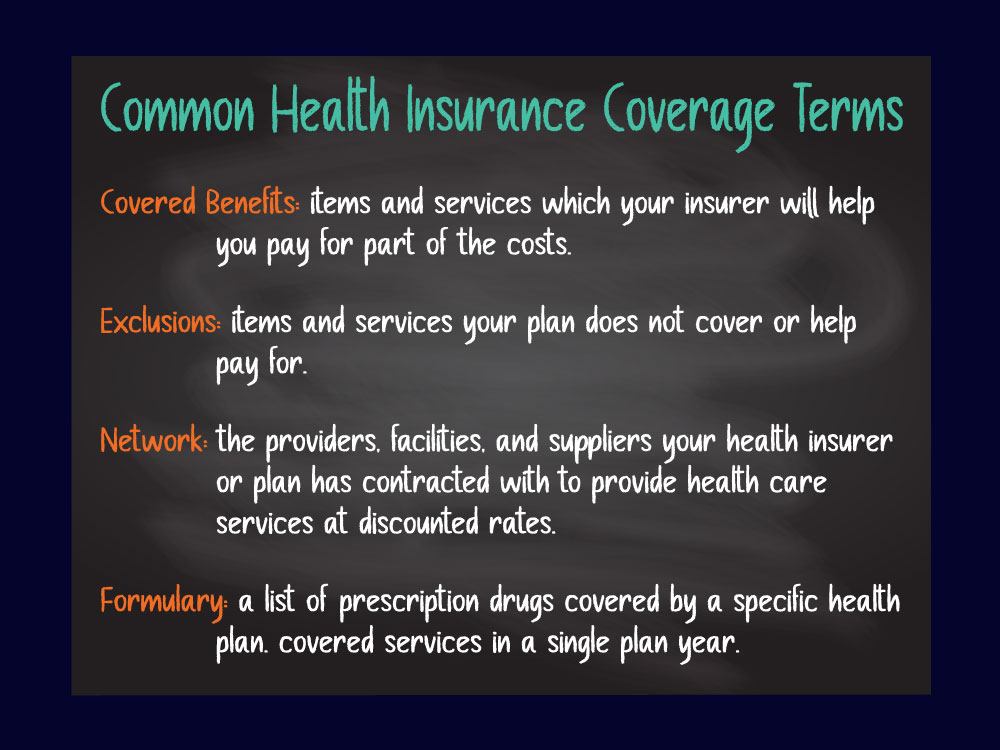
Health insurance doesn’t cover all of your medical expenses. So, you will need to pay attention to your plan’s coverage documents. Look for a Summary of Benefits and other documents that define which items and services are covered benefits under a health insurance plan. These are services and items your insurer will help you pay for, depending on your plan.
Note: Affordable Care Act (ACA) Marketplace plans, as well as all new individual and small-group health insurance policies since 2014, must cover a list of essential health benefits.
Health plans also list excluded services (non-covered benefits), which are items and services your plan does not cover or pay for. Common exclusions include travel vaccines, massage therapy, alternative therapies, cosmetic procedures, experimental treatments, gym memberships, treatments or services your plan considers not medically necessary, etc.
Note: Alternative health plans, such as health care sharing ministries, are not regulated by ACA mandates. They can have many exclusions that Marketplace plans must cover, such as treatment for pre-existing conditions, routine preventive care, prescription drugs, reproductive care, mental health and substance abuse treatments, and more.
Network
A network is the providers, facilities, and suppliers your health insurer or plan has contracted with to provide health care services at discounted rates. It includes providers such as primary care doctors, specialists, therapists, and other licensed healthcare providers. It also includes hospitals, clinics, labs, pharmacies, imaging centers, etc. By using in-network providers, you pay less out-of-pocket. Your health insurance plan may pay nothing to very little for planned, out-of-network health care.
Note: Networks change, so always confirm with your health plan that your providers and facilities are in-network at the time you receive care.
Formulary
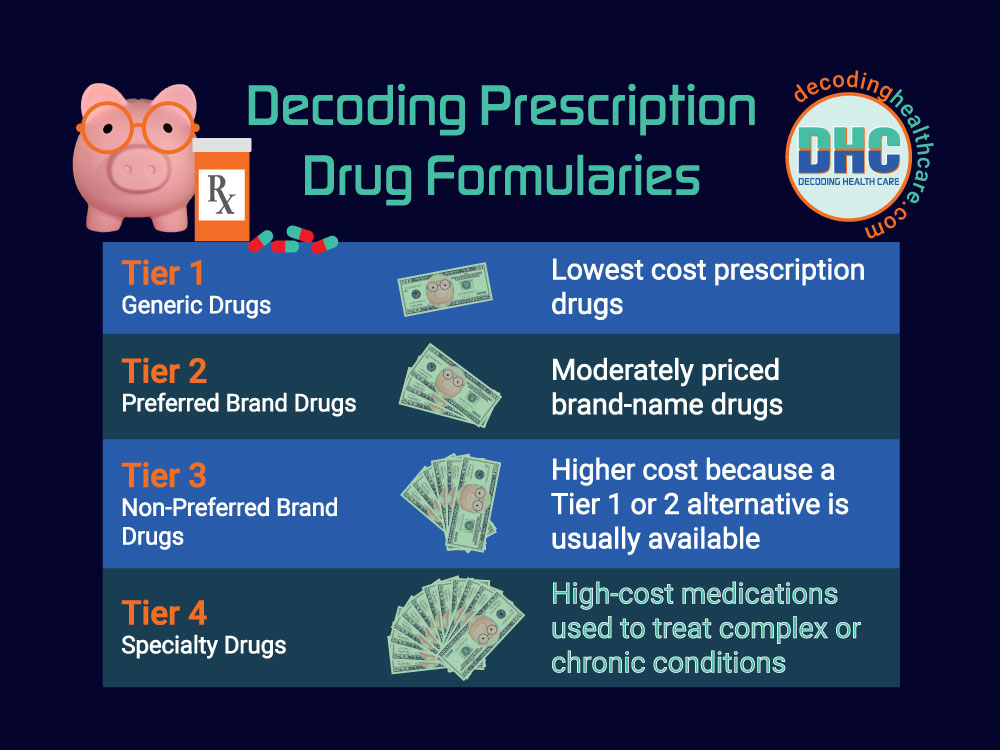
A formulary is a list of prescription drugs covered by a specific health plan. You can use your insurer’s online portal to verify if your exact prescription is covered and what tier it falls under. Formularies are divided into tiers or categories, which determine your out-of-pocket costs:
- Tier 1 (Generic Drugs): Prescriptions with the lowest copay or coinsurance.
- Tier 2 (Preferred Brand Drugs): Moderately priced brand-name drugs that the insurer prefers.
- Tier 3 (Non-Preferred Brand Drugs): Higher cost because a preferred or generic alternative is usually available.
- Tier 4 (Specialty Drugs): High-cost medications used to treat complex or chronic conditions.
Note: Insurance companies update their formularies periodically throughout the year as new drugs are released or prices change.
Check out our Health Insurance Glossary for more health insurance terms.
Learn about Health Insurance and the Alternatives

Our book, Decoding Health Insurance and the Alternatives: Options, Issues, and Tips for Saving Money, by Lauren R. Jahnke, MPAff, is a comprehensive, non-partisan consumer guide to understanding the current U.S. system for health insurance and getting health care. It includes many practical tips to help you save money, whether you have insurance or not.
Additionally, you can subscribe to our free monthly newsletter, the DHC Insider. You’ll stay up to date on recent national issues and legislation affecting healthcare affordability. You’ll also get the latest tips, resources, tools, and hacks to spend less on health care, whether you are insured or not.
Conclusion
Health insurance literacy begins with an understanding of the basic vocabulary of health insurance terms. With it, you’ll make better, more informed choices that help protect both your health and financial wellness.
Article by Lauren R. Jahnke, MPAff, author of Decoding Health Insurance and the Alternatives: Options, Issues, and Tips for Saving Money, and Julie Gunstanson, Certified Medical Billing Advocate.
Article Last Updated: 9-14-2026
Disclaimers and disclosures: This article provides general information about healthcare options. For guidance specific to your situation, consult insurance brokers, financial counselors, billing advocates, legal assistance, or other experts in your area, as appropriate. Decoding Health Care provides independent and educational information and does not endorse any specific insurance plans or health coverage products. AI tools were used to assist with researching this article; however, human subject-matter experts always extensively revise, fact-check, edit, and approve our content. Affiliate disclosure: GoodRX is an affiliate link that supports our content.

Do You Have a Medical Bill You Can’t Afford or Medical Debt in Collections?
Before you pay that big medical bill, read this!
Get our Free Medical Debt Quick Start Guide and learn the first steps to take before sending a dollar to a medical provider or collection agency.
By submitting this form, you agree to receive educational emails from Decoding Health Care, our free guide, and our free monthly DHC Insider, an educational newsletter focused on protecting your finances from high healthcare costs and medical debt—with or without insurance. You may unsubscribe at any time. Click here for our Privacy Policy